enrollment
What We Learned This Year: Eight Reports, Thousands of Voices, and One Clear Message About Students

Every year, I have the opportunity to stand at the intersection of student voices, fresh research, and campus decision-making. It is this vantage point I never take for granted. I get to listen, really listen, as students and their families try to make sense of one of the biggest choices they will ever face. And honestly? The data always surprises me. It knocks me off balance, in the best way, and keeps me rethinking how this work should be done. But this year felt different, and not just in the numbers.
We conducted eight studies and heard from tens of thousands of students. Thousands of families shared their experiences with us. We also surveyed campus professionals at hundreds of institutions.
When I step back and look at it all, one message just echoes above the rest: Students want to succeed. They are not asking for a handout. They are just asking us to meet them where they are. No matter the dataset, the demographic, or the question, it was there, a kind of quiet message threading through every open-ended response: “I’m trying. Please help me in a way that works for me.”
Here is what I learned from all the students, families, and schools that trusted us with their stories this year. I have also listed the reports for each finding, which you can download and explore.
1. Students start earlier, search differently, and expect more from digital experiences.

Every year, I meet a new wave of students. Many are Gen Z, and the youngest are now part of Gen Alpha. These students do not just move nimbly through the internet. They approach it with a clear set of expectations.
They want websites to be easy to use and up-to-date. They want virtual tours to feel real, not packaged or staged. When they watch a video, they hope it speaks to them, not over their heads. They want answers quickly, but they also want to feel a sense of care and connection.
There is so much coming at them all at once. The choices are overwhelming. But even before they reach out to a human being, many are already wondering: “Can I picture myself at this college?”
Their search is emotional before it is analytical. And they need us to show up fully, with clarity, transparency, and responsiveness.
2. Institutions are truly trying, but capacity gaps get in the way.
A pattern that stood out this year: the divide between what students hope for and what most colleges feel they can provide. Colleges care deeply and want to meet the needs and expectations of students, but their systems and staffing simply lag behind students’ wants and needs. Here are just three examples:
- Students love personalized videos; however, many colleges continue to struggle with creating them.
- Students want information that is tailored for where they are in 10th, 11th, or 12th grade, but most schools find it tough to do this consistently.
- Students respond well to SMS reminders and instant guidance, yet some colleges hold back, worried about being intrusive.
This is not a willingness issue. It is a resourcing issue. It forces us to rethink what “meeting students where they are” looks like, not just emotionally, but operationally.
3. Families remain the quiet (and sometimes not-so-quiet) force behind every decision.
Families have been clear about what they need from us. Communicate, early and honestly. Talk about cost in real terms. Help us understand what comes next, and what this investment might mean for our children.
Families are not trying to control the process. They want to feel assured that their sons and daughters will be okay. It matters that families feel the investment is worth it, that their students will be supported, and that there is a clear path forward. At the same time, many families still struggle to obtain answers to even the most basic questions about costs, aid, or outcomes.
We cannot truly support students while ignoring the people quietly cheering (and sometimes worrying) behind them. Equity means working in partnership with families, especially those walking into higher education for the first time.
4. First-year students are deeply motivated and deeply worried.
This report broke my heart, I have to be honest!
Almost every first-year student says they want to finish their degree. They want to learn. They want to belong. They want to shape a future they can be proud of.
Yet more than a quarter are already doubting whether college will be worth it, sometimes even before their first class.
Their requests are not grand or out of reach. They want to make friends. They want to find the right major. They want to understand how careers really work. They want to know how to study well. They want advice on scholarships. These are not demands; they are invitations. Show them they belong. Prove that their presence matters here.
Belonging is not a catchphrase. It is the foundation for everything else. These are not demands. They are invitations: “Show me I matter here.”
5. Many students feel that institutions do not provide adequate financial aid.
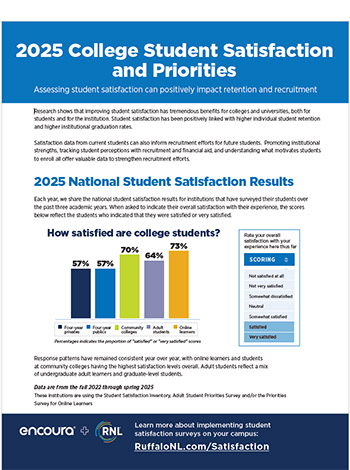
Cost is a driver for enrollment and the biggest barrier for families. Knowing how much financial aid they are eligible for can go a long way toward alleviating the stress of financing an education.
However, across the board, about half of all students are not satisfied with the availability of financial aid. When looking at students at four-year private institutions, four-year public institutions, and community colleges, more than 80% said that adequate financial aid was important. Yet only half said they were satisfied that adequate financial aid was available. Adult students expressed similar levels of satisfaction.
Given the enormous investment students and families make in a college education, we have to design processes that educate them early on the aid that is available, explain their actual cost of attendance is, and share outcomes to illustrate how their college education can lead to a better life.
6. Retention is not a mystery. We know what works; the challenge is scaling it.
There were no huge surprises about what helps students stay and succeed. Academic support. Mental health services. Early alerts. Success coaches. We know these things work.
What is striking is how many places struggle to get support from every student who needs them. AI-powered tools are helpful, but not every campus utilizes them. Early assessments can significantly impact a student’s trajectory, but they are not universally applicable. Cross-campus plans work best, but not every college has enough hands-on deck to pull it off.
Retention is not something one office “owns.” It is a campuswide philosophy grounded in clarity, coordination, and community.
7. Gen Z are becoming the largest population of graduate students, and they expect more personalization
It’s hard to believe that Gen Z is already moving on to graduate school, but that shift is well underway. The National Center for Education Statistics showed that, by fall 2023, 26% of graduate students were under 25 and 30% under 29.
That means that the majority of graduate students are digital natives who have grown up online and are used to those online experiences being personalized and curated for them. When we conducted this year’s graduate student survey, 53% of our respondents said that personal contact was essential or very important to them in choosing a program.
More than ever, graduate student recruitment needs to feel like it speaks to students and addresses their goals, their interests, and their needs.
8. AI is not replacing people; students want us to help them use it safely and ethically.
This one surprised me the most. Whether students are wary of AI or jumping in, nearly all say the same thing:
- They want guidance.
- They want an advisor to help them use these tools wisely.
AI itself is not the enemy. Pretending students are not already experimenting with it would be the real mistake.
Students are not asking us to choose between AI and human connection. They are asking us to integrate both thoughtfully and responsibly.
What all eight reports taught me
Students are trying incredibly hard in a system that was not always built for them.
Our job is to build the bridge, not ask them to leap. Meeting students and families where they are is not a tagline. It is a responsibility. It looks like:
- Clear digital pathways for exploration
- Transparent communication for families
- Personalization so students feel you are speaking to them
- Support that begins early and never stops
- Belonging as a core institutional value
- Career clarity embedded throughout the journey
- Financial transparency without fine print
- AI literacy paired with human connection
And above all: Designing every process with equity at the center, not at the margins.
Because students are ready. Families are ready. They are doing everything they can.The real question is whether we are ready to meet them with the honesty, empathy, and support they deserve.
You can find all of these reports in our Resource Library. And if you want to talk about how you can turn these insights into strategies that will help you engage, enroll, and retain more of your students, reach out to us. We can schedule a time to talk about meeting more students where they are and meeting your enrollment goals.
More insights from our colleagues at Encoura
After an exciting year of joining forces, the Encoura + RNL teams have reflected on their top insights for 2025. Here are additional takeaways and research you won’t want to miss.
- Top Takeaways From Our Analysts: Traditional Student Demand
Three Eduventures analysts reflect on the past year and share the one top insight that truly stood out to each of them. - Top Takeaways From Our Analysts: Non-Degree Demand and Program Innovation
The top lessons learned by Eduventures analysts in the non-degree market and in program innovation.
Talk with our experts about enrollment and student success
Let’s talk about how you can find the optimal strategies for engaging the students who are the best fit, optimizing yield, and maximizing student success.
About the Author
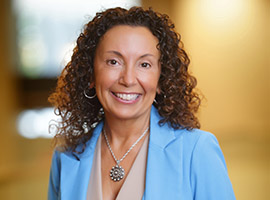
Dr. Raquel Bermejo is a dedicated education researcher with a passion for understanding the college search and planning experiences of high school students and their families. Through her analysis of existing data and original research...
Read more about Raquel's experience and expertise
Reach Raquel by e-mail at Raquel.Bermejo@RuffaloNL.com.