.
The Challenge: Grow In-State Enrollment
North Carolina A&T needed to optimize financial aid packages for students more strategically, with a focus on enrolling more in-state students to help maximize the state’s funding model. Joseph Montgomery, associate vice provost for enrollment management, recognized the university’s internal processes were the core issue. The financial aid and enrollment teams lacked detailed insight into how their packaging decisions truly affected enrollment. Montgomery admitted that the team was: “constantly looking for material weaknesses in our process and… not oriented enough with what was really happening in the aid side of the house.”
Ultimately, the desire to correct these flawed internal systems and find a partner who could deliver on promised “pie in the sky” results is what pushed them to trust and lean into RNL’s financial aid optimization.
The Solution: From Manual Struggle to Algorithmic Success
For the first two years of using the financial aid model, the university faced internal implementation challenges, leading Montgomery to admit they “stubbed their toe.” The model used proprietary econometric modeling to deliver accurate, data-driven packaging recommendations, and regularly met with his RNL consultant for support throughout the recruitment cycle. However, according to Montgomery, the university continued to lack the process to fully implement those recommendations. The team attempted to manage the complex, data-driven suggestions using a manual process that Montgomery recognized as being unsustainable. He noted that they didn’t initially fully operationalize the financial aid model during their first two years with the solution and used it more like a general guide instead of a standard.
The Turning Point
The turning point came when the team shifted from just analyzing the model data to successfully integrating RNL’s advice operationally. They realized true success required understanding the mechanics of building the aid packages. By embedding the awarding model, which included 55 unique student types for both in-state and out-of-state students, directly into their system, the packager could automatically implement the precise recommendations, successfully yielding the desired students.
“We wanted to be super aggressive with our in-state students to improve the yield rate, and we wanted to turn down the yield rate on our out-of-state students,” said Montgomery. “We were spending a lot of money to get our out-of-state students to be comfortable saying yes to A&T.”

“We wanted to be super aggressive with our in-state students to improve the yield rate, and we wanted to turn down the yield rate on our out-of-state students,” said Montgomery. “We were spending a lot of money to get our out-of-state students to be comfortable saying yes to A&T. RNL helped us change that, and we are so pleased with our enrollment numbers!””
This systemic change also required subsequent training for the admissions and financial aid teams to lead with the best possible financial aid offer first, to speak with confidence about the value of a North Carolina A&T education, and to be comfortable holding the line on the initial financial aid amount, even if it meant losing a few students.
In addition, the university leveraged regular check-ins with their dedicated account representative Katherine Cooper. She provided crucial support by continually reviewing the performance of each student segment against its goals and assisting the team in making necessary adjustments.
Cooper emphasized that success with the financial aid model requires active management, not automation. “This isn’t a ‘set it and forget it’ model,” Cooper explained. “The real power comes from trusting the data and committing to continually review and adjust your strategy based on how enrollment numbers are actually tracking against your goals throughout the year. I love partnering closely with institutions, acting as an extension of their strategy team, and helping them successfully bring in the class they’re striving for.”
This hands-on partnership and data review were key to the team’s success. “It was great to have a different set of eyes taking a look at what’s happening with our yield,” added Montgomery. “We would have a regular cadence with Katherine and we uploaded our information into the modeling environment every week. And there were times where Katherine would call, and she would actually talk about areas that she saw material weakness. Those calls were so incredibly valuable.”
The pivot to fully integrating the financial aid model resulted in immediate and substantial dividends in Fall 2025. North Carolina A&T not only achieved its enrollment targets but also shifted its student profile, setting a new standard for data-driven success. “I started telling the Provost Office in March that they didn’t have enough sections planned for fall. I saw our enrollment increases coming, especially as we got into June and a higher percentage of students than normal were signed up and showing up for our new student registration days,” said Montgomery. “All of our indications were that it was going to be a very a strong class, and we were right.”
The Results: Exceeding Overall Enrollment Targets and a Dramatic Growth of In-State Enrollment
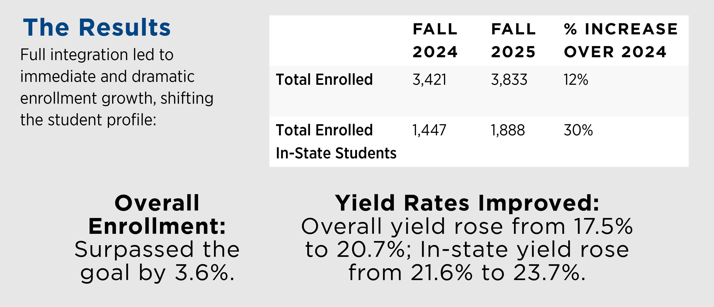 The university successfully enrolled 3,833 new first-year and transfer students for Fall 2025. This achievement was a strong 12% increase over the previous year’s class of 3,421 new students and surpassed the university’s Fall 2025 goal of 3,700 by 3.6%. The precise packaging strategy also improved student commitment, resulting in the overall yield rate to jump from 17.5% in Fall 2024 to 20.7% in Fall 2025.
The model’s greatest success was in-state student enrollment, vital for maximizing the state’s funding model. The university enrolled 1,888 new in-state students in Fall 2025, marking a massive 30% increase over the previous year of 1,447 new in-state students. This result blew past the internal goal of students by 13%. In addition, the in-state yield rate improved from 21.6% to 23.7%, confirming the effectiveness of the targeted financial aid strategy in attracting the desired students.
What’s Next: Sustaining Success
Having achieved record enrollment and strategic in-state growth, North Carolina A&T successfully corrected its financial aid challenges and established a robust, data-driven system. The institution now looks forward, focusing on converting this successful foundation into long-term operational excellence.
“The conversation has shifted on campus this fall. My administration now knows we can get the students. We’re now focused on refining our processes to keep this momentum going so the success we celebrated this year can happen again,” said Montgomery. “Financial aid optimiization and RNL made the difference for us. Everyone promises the pie in the sky, and very few actually get you that pie. RNL definitely got us the pie.”
Ready to Learn More About Advanced Financial Aid Optimization from Encoura+RNL?
See how our financial aid optimization and fully customized net price calculator can empower your students and transform your yield strategies.