student success
Five Data-Informed Steps for Optimizing College Student Retention
Where do you start as you are creating a student retention plan? The answer is with data. Simply put, data are the lifeblood of successful student recruitment and retention efforts. You cannot possibly hope to maximize enrollment yields and student completion rates without strong data analysis and planning. The following five steps illustrate how to achieve a robust, data-informed approach to retention.
1. Make data the foundation for decision-making.
It sounds simple, yet we know that many campuses do not rely on data to guide strategies. Often “conventional wisdom” or “that’s the way we’ve always done it” override any actual research or data. Those types of processes are very flawed for crafting enrollment strategies, especially given the rapid changes that are reshaping the higher education environment.
2. Collect all the data that are relevant to student success.

In discussing student retention, first-to-second year persistence and overall completion/graduation rates are useful metrics. However, they are lagging indicators gathered only after it is too late to intervene with students and do not provide a complete picture of persistence patterns. There are many data elements that can help not only provide a more accurate assessment of retention at your campus, but also allow you to intervene with students in a more timely fashion such as:
- Student motivation data. How do students feel about attending college? What are their attitudes toward studying? What family and/or social factors could interfere with their success? Motivational data can go a long way toward focusing your student retention initiatives, especially when gathered as students first enroll at your institution. (Learn more about the motivational assessment tools that are available to support your efforts).
- Credit hours attempted versus credit hours earned. This ratio is very revealing as it demonstrates if students are succeeding in their educational plans before reaching the critical juncture of withdrawing. These data can be especially helpful during a student’s first and second semesters.
- Student satisfaction and priorities assessment. When students are not satisfied, they become less likely to persist. Improving their satisfaction improves the quality of their life and learning. When satisfaction is viewed within the context of importance (priorities), the data allows you to better understand which satisfaction issues are more pressing and in need of immediate attention. (Take a look at the satisfaction-priorities surveys options).
- Common characteristics in student retention. Do students who persist or withdraw share common characteristics? Are there indicators of student success or red flags for persistence that would help you quickly understand which students you should target? (Contact me if you would like to learn more about data analytics options for retention guidance).
- Institutional barriers to student success. Similar to student characteristics, are there certain factors across campus that may hinder persistence and completion? Conducting an opportunity analysis with an outside perspective can help you identify places where you could make improvements.
3. Understand what the data are telling you
Once you have made a commitment to collect the data and have gathered what you need to inform your decisions, you may ask yourself, “Now what?” This is your turning point for using data to improve student retention. You have to know what the data say about student persistence. Are there patterns to observe? Do you know which students or cohorts to prioritize? Which resources are having the greatest impact on student success? This is admittedly one of the more difficult tasks in data-informed retention planning and one where experience can make a big difference. However, once you successfully analyze your data, your retention efforts have the potential to improve!
4. Take action based on the data
Here we close the loop with steps one and two. Now that you are informed by data, you can build retention initiatives on solid information. You will be able to focus your limited resources more strategically on the students who need the most help and/or are the most receptive to assistance. You will be able to direct your attention to improving areas that matter to students. You will be able to be proactive based on the knowledge of characteristics of successful (and less successful) students. The power of data comes when your institution takes action based on what it has learned about your students.
5. Use what you know about retention to guide recruitment
There is a tendency to look at student recruitment and retention as two unrelated silos. But one of the biggest factors in student retention is the shape of the incoming class. It is vital for campuses, when recruiting, to extend their concept of the funnel past the initial enrollment state and through the career of the student. By determining which students not only have the desired characteristics you want, but also the best chance to persist and success, your entire campus benefits.
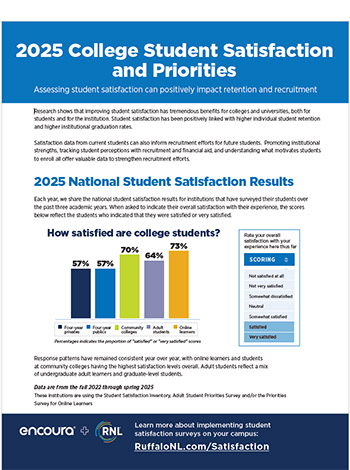
Are you curious about how institutional choice plays into student satisfaction (the idea that students have enrolled in the college they want to attend), along with importance factors in the decision to originally enroll and how satisfied students are with financial aid? (All of these are links between recruitment and retention efforts). If yes, I invite you to download the 2025 National College Student Satisfaction and Priorities Report.
If you are looking for support with data collection, data analytics and/or understanding what opportunities exist for your campus in the area of student success, contact me to learn more.
Thanks to my former colleague Tim Culver for the original development of this content.
About the Author

Julie L. Bryant, vice president for student success at RNL, works directly with colleges and universities throughout North America in the area of satisfaction assessment. Julie is responsible for client service to more than 2,700 institutions...
Read more about Julie's experience and expertise
Reach Julie by e-mail at Julie.Bryant@RuffaloNL.com.